
Freight & Logistics News
Curated industry updates from trusted freight, logistics, transportation, and supply chain sources.
-
Autonomous Trucks Are Here: Einride’s 27% Revenue Jump
Autonomous trucking is moving from pilot talk to real freight ops. Einride CEO Roozbeh Charli breaks down 27% revenue growth, a 60% jump in driverless hours, the Amazon middle-mile rollout, and the plan for 500 Tesla Semis on its platform. The conversation gets into what matters for carriers and fleet operators: where autonomous trucks actually…
VEHO Industry Update: This article highlights developments relevant to the freight, logistics, and supply chain industry.
-
Reefer Rejections Stay Hot as Intermodal Wins 33%
Reefer tender rejections are still running hot while van and flatbed cool off. The big swing factor: intermodal savings are now around 33%, pulling more freight off the road while refrigerated freight stays less flexible. In this SONAR Daily Update, FreightWaves breaks down reefer rejection trends, flatbed seasonality, rail container volume strength and what mode…
VEHO Industry Update: This article highlights developments relevant to the freight, logistics, and supply chain industry.
-
AI for Supply Chain Needs 3 Things: Goods, Data, Money
AI agents will be commoditized in months. In supply chain, the real moat is the data foundation underneath them. Valentina Jordan, CEO and co-founder of Nauta, breaks down why global trade AI only works when movement of goods, data and money are connected. She explains the ‘operational brain,’ how it learns from ERP, TMS, WMS,…
VEHO Industry Update: This article highlights developments relevant to the freight, logistics, and supply chain industry.
-
One man paints challenging outlook for brokers’ insurance
It’s just a single report and the words of one person quoted in it, but an outlook by TD Cowen on what broker insurance might do in the wake of the Montgomery decision is sobering. In a report from the transportation team at TD Cowen led by managing director Jason Seidl, based on a phone…
It’s just a single report and the words of one person quoted in it, but an outlook by TD Cowen on what broker insurance might do in the wake of the Montgomery decision is sobering.
In a report from the transportation team at TD Cowen led by managing director Jason Seidl, based on a phone call with an unidentified “trucking insurance agency executive,” TD Cowen said what it has heard so so far on the looming rise in insurance premiums for brokers due to Montgomery fallout has been enough that “commentary from our call keeps us negative on the brokers.”
That negative outlook at TD Cowen is for three companies, TD Cowen said: RXO (NYSE: RXO), C.H. Robinson (NASDAQ: CHRW) and Landstar (NASDAQ: LSTR).
The Montgomery decision from May removed liability and negligence protection for brokers that had been provided by several court decisions involving an interpretation of the Federal Aviation Administration Authorization Act (F4A).
Tripling of premiums
TD Cowen said an unidentified “top 10” freight broker recently saw a tripling of its liability insurance that was recently renewed.
Overall, TD Cowen said, “we estimate that large brokers currently have (approximate) mid-teens rate and mid-20’s rate (increases)…that imply material premium inflation.”
TD Cowen’s guest commentator said there was likely to be “sizeable inflation” in insurance premiums.
And it’s not as if the brokers can easily turn to competitors for a cheaper quote. “There are only ~10 underwriters involved in broker auto liability that will likely decrease over time,” TD Cowen said, with the likelihood that will decline to eight in the future.
That group of ten insurers already has shrunk, the report said: “exits have already begun with two observed recently.”
The specifics on a recent increase in premiums, TD Cowen said, is that “a large broker which the agent secured coverage for saw premium costs increase from $3 million to $10 million in their excess coverage layer above the $15 million primary layers.”
Up and down post big decisions
What constitutes a level of acceptable coverage beyond the “primary layer” both after the Montgomery Supreme Court decision and the $600 million nuclear verdict against C.H. Robinson in the case of Lipe vs. Lupus Superior has thrown the insurance market into volatility just in the last three to four months, Seidl said.
The insurance executive interviewed by Seidl said post-Montgomery, which came down May 14, “everything went ballistic,” Seidl said. But insurance rates after that first surge fell, according to the insurance executive, “then post the Lipe case (which produced its nuclear verdict in late July), everything started going haywire again.”
Seidl said in an interview with FreightWaves that the view of the insurance executive is that sort of volatility “is a clear sign that the insurers aren’t yet comfortable with the amount of liability they’re taking on, because they’re trying to assess it themselves and it’s quickly developing. So it matters when you renew.”
Nobody’s rushing to take their place. “Appetite to reinsure this group of carriers has also diminished with some recent exits,” the report said. “Underwriters are still in early stages of pricing and could see more inflation ahead as they analyze loss rates and risk.”
Brokerage universe to shrink?
The guest executive added his voice to a growing view that Montgomery, and the list of higher costs that will come with it in insurance and vetting, will combine to reduce the number of 3PLs operating in the market.
“Our panelist believes that over time we should expect industry consolidation among
freight brokers,” the TD Cowen report said. “With roughly 22K brokers in the industry, the top 100 control 84%; smaller carriers will likely face unsustainable insurance headwinds in the coming years.”
Shippers are going to look closer at their carriers or the brokers that hire them, the insurance executive said, according to TD Cowen, even though recent attempts to drag shippers into negligence cases have fallen short.
The end result, the TD Cowen report said, is that “small brokers will face increased scrutiny from their shipper base, impacting their top line, and insurance headwinds (and the lost ability to cut corners) should pressure margins.”
C.H. Robinson and RXO more assuring
The somewhat apocalyptic tone of the TD Cowen report, and the statements of the guest commentator from the insurance industry, stand in stark contrast to comments made by C.H. Robinson CEO David Bozeman at a recent investors’ conference hosted by Deutsche Bank.
According to a transcript of his remarks, Bozeman said insurance “on a gross revenue basis is a very immaterial number for us.”
That doesn’t mean the company expects their insurance costs to hold steady, Bozeman said. “We do not believe this inflation is going to drive it to a material number for us going forward,” Bozeman said. “And whatever that inflation is, we’ll offset that and continue to deliver the results that we’ve been delivering.”
But more broadly, Bozeman said the higher costs faced by brokers will eventually blend into the landscape.
“Ultimately, that cost will become part of the freight rate environment,” he said. “It will become part of every load we quote, and it will become part of the shippers’ cost, and it will be passed on to consumers. So we do not see a scenario where higher insurance cost is just a burden that we will absorb 100%. Ultimately, like every other inflation, the consumer will ultimately pay the cost.”
The advantage of a larger 3PL in securing insurance rate increases that will be less than smaller competitors was also alluded to at that Deutsche Bank conference by Jared Weisfeld, the chief strategy officer at RXO.
“Given what we’ve seen over the last couple of years because of…the (RXO) safety record, the processes, the compliance, we’ve outperformed significantly over the last few years, and our expectation is that heading into 2027, we will outperform again,” he said about potential rate increases.
Weisfeld echoed Bozeman in discussing who will pay the ultimate cost. “Costs will get passed along to shippers and then eventually the end consumer, where ultimately, if the cost of doing business goes higher, we need to still earn a fair margin,” he said.
Seidl said in his interview that it might not be that easy for a broker looking to add to their coverage first absorb and then pass on the cost.
“A lot of brokers are trying to go above $50 million now because other than the really large brokers, you didn’t have a lot of guys insured for over $100 million,” Seidl said. “I think some of them are going to want to do that, but they’re going to find that insurance a hell of a lot more expensive.”
More articles by John Kingston
The list grows: 2 more cases proceeding on broker liability
Likely BMO swan song shows trucking credit strengthening
A newcomer to Roadcheck driver violations top 5: speaking English
The post One man paints challenging outlook for brokers’ insurance appeared first on FreightWaves.
-
Georgia authorities intercept 1,800 pounds of marijuana in shipment headed toward Atlanta, Orlando
Butts County authorities intercepted approximately 1,800 pounds of marijuana Tuesday morning, Sheriff Gary Long announced. Long posted a public statement at 12:13 p.m. Tuesday. The shipment originated in Sacramento, California. It carried marijuana toward destinations in Atlanta and Orlando. Long wrote that roughly half of the load would go to Atlanta. The remaining marijuana would…
Butts County authorities intercepted approximately 1,800 pounds of marijuana Tuesday morning, Sheriff Gary Long announced. Long posted a public statement at 12:13 p.m. Tuesday. The shipment originated in Sacramento, California. It carried marijuana toward destinations in Atlanta and Orlando.
Long wrote that roughly half of the load would go to Atlanta. The remaining marijuana would travel to Orlando, Florida. Georgia permits marijuana only through limited medical provisions. Florida allows medical marijuana, while California permits adult recreational use.
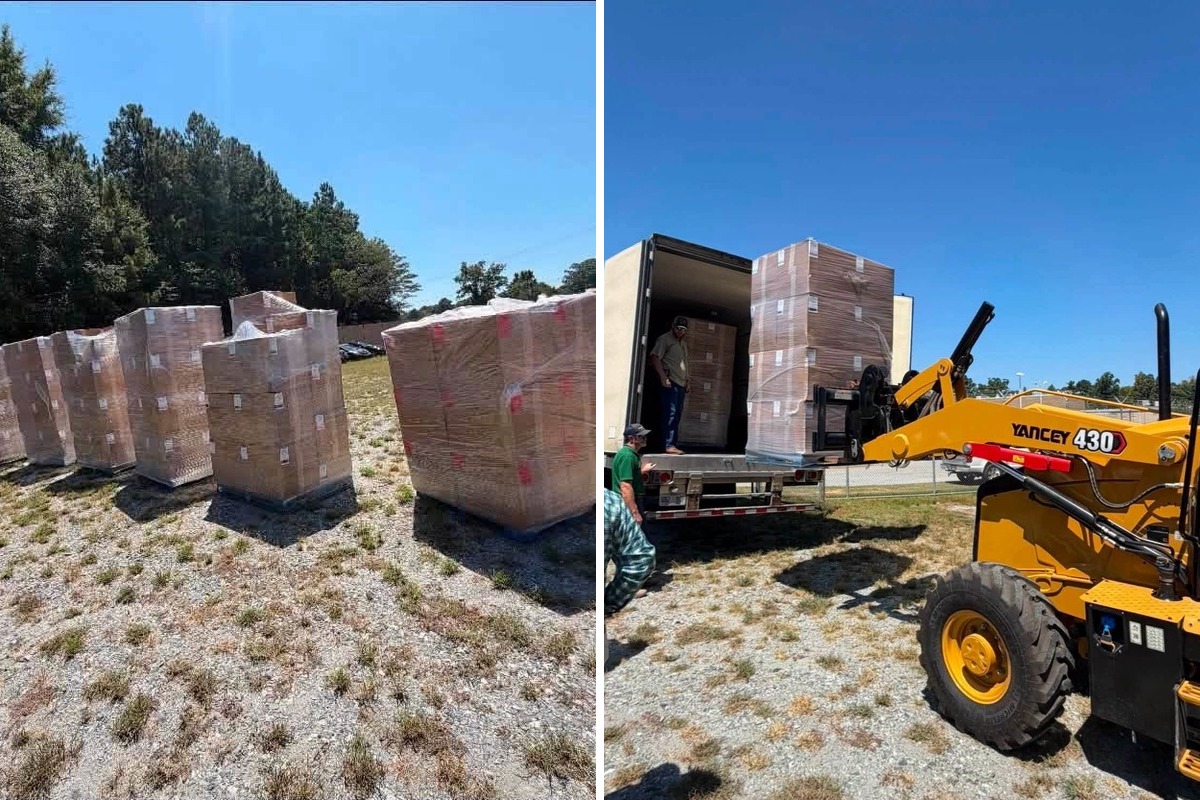
Sheriff’s office photos show palletized boxes outside and inside the trailer connected to the Butts County marijuana seizure. (Photo: Butts County Sheriff’s Office) Sheriff warns of interstate illicit trade
Long framed the seizure as evidence that state legalization cannot end illicit marijuana sales. “But here is the reality: the black market isn’t going away,” he wrote. “The illegal marijuana trade does not stop at the state line,” Long added. His statement warned Georgia lawmakers against treating legalization as a complete solution.
The release described Mexican drug-trafficking organizations and other criminal groups as major interstate suppliers. Long argued that their operations continue despite legal cannabis markets. His statement did not connect this particular load to any named cartel. Officials have not announced a connection to a specific organization.
Long wrote that legal businesses face taxes, licensing fees, testing requirements and regulatory costs. He argued that criminal organizations avoid those expenses. That difference, he wrote, lets illegal sellers undercut licensed competitors. He also warned that high entry costs can give organized crime another advantage.
Long compared the issue to Prohibition. He argued that government cannot legislate away demand or the black market. His statement cited unsuccessful Colorado efforts to repeal personal-use provisions after legalization. It also referenced California’s repeated tax and regulatory changes.
Long urges lawmakers to study other states
The sheriff urged Georgia lawmakers to study those states before changing their own laws. “That should be a warning to Georgia,” Long wrote. He criticized discussions in Atlanta and Washington, D.C. Long also questioned whether marijuana lobbyists influence some lawmakers.
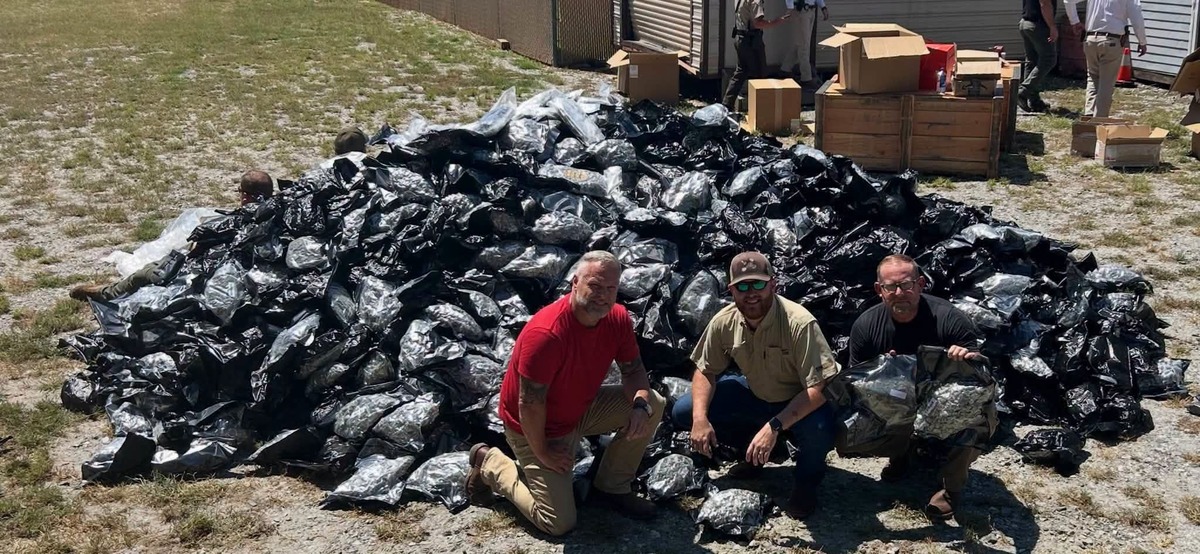
Three men kneel beside bags and boxes containing approximately 1,800 pounds of marijuana that Butts County authorities intercepted from a Sacramento shipment headed toward Atlanta and Orlando. (Photo: Butts County Sheriff’s Office) Long wrote that his statement did not settle the legalization debate. Instead, he urged legislators to create a smarter approach before any broader change. He predicted Georgia would spend years revising poorly written legislation after legalization. “Georgia, let’s get it right the first time,” Long wrote.
DEA Atlanta directed FreightWaves to the Butts County Sheriff’s Office for case questions. The agency offered no additional details. Long’s release does not identify a person or business connected to the shipment. It also does not announce arrests or charges.
Why It Matters
Cargo theft is not the only threat moving through freight networks. Drug traffickers can exploit the same routes, trailers and handoffs that legitimate shippers use every day. That makes freight visibility and clear communication between every party handling a shipment critical when something does not match expectations.

Click here for more articles on cargo theft and freight fraud by Phil Brink.
Deputies recover $150K in New Balance shoes after BNSF boxcar burglary – FreightWaves
Police recover $258K copper load from stolen J.B. Hunt trailer in North Carolina – FreightWaves
CBP finds $9.5M in meth hidden inside detergent shipment at Texas border – FreightWaves
The post Georgia authorities intercept 1,800 pounds of marijuana in shipment headed toward Atlanta, Orlando appeared first on FreightWaves.